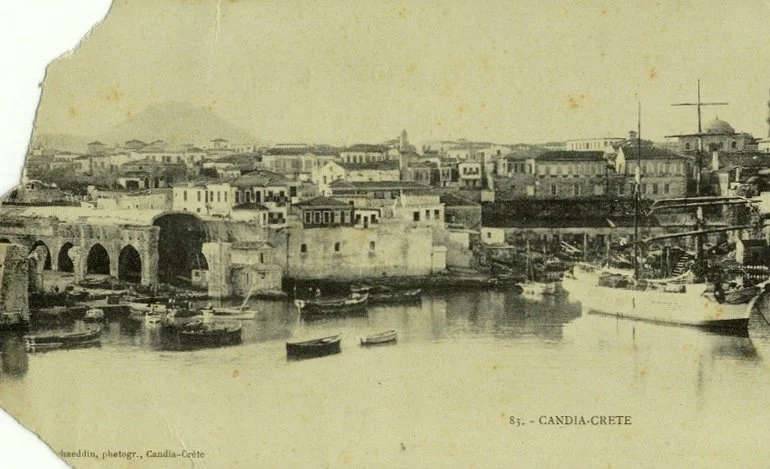
Known to British officials as Candia, nineteenth-century Herakleion was an Ottoman port inhabited principally by Christian and Muslim Cretans, alongside smaller foreign and commercial communities. The British consulate observed a society shaped by maritime trade, competing political loyalties and recurring political struggles over the future of Crete.
Consular work extended far beyond formal diplomacy: British representatives gathered political and commercial intelligence, protected British subjects, assisted shipping and maintained relationships with Ottoman authorities, local notables and the island’s different communities.
Herakleion also exposes the dangers faced by locally embedded consular representatives. During the violence of September 1898, the British Vice-Consul Lysimachos Kalokairinos, members of his family, British servicemen and hundreds of Cretan Christians were killed; the British consulate and much of the Christian quarter were burned. The crisis accelerated the departure of Ottoman troops and the establishment of the autonomous Cretan State.
FURTHER READING
Peçe, Ugur Z. Island and Empire: How Civil War in Crete Mobilized the Ottoman World. Stanford, CA: Stanford University Press, 2024.
Barchard, David. “The Fearless and Self-Reliant Servant: The Life and Career of Sir Alfred Biliotti (1833–1915), an Italian Levantine in British Service.” Studi Micenei ed Egeo-Anatolici 48 (2006).
McTiernan, Mick. “‘The Most Awfully Rotten Job Altogether’: British Troops in Crete, 1897–1899.” Journal of the Society for Army Historical Research 99, no. 398 (2021): 312–338.