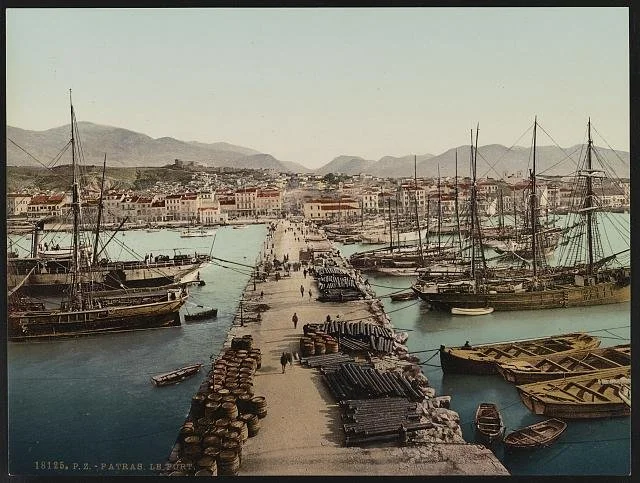
During the nineteenth century, Patras developed into one of the principal commercial ports of the Greek kingdom. Its prosperity rested above all on the cultivation and export of currants, which connected the surrounding countryside to markets in Britain and western Europe. British merchants and commercial houses became prominent members of an increasingly international urban community.
The British consulate stood at the intersection of these commercial and social worlds. Consuls monitored shipping and commodity prices, reported on political and economic conditions, protected British subjects and assisted merchants and seafarers. Their correspondence allows us to trace relationships among diplomats, exporters, shipowners, local officials, cultivators and to examine how information gathered in a provincial port travelled to Athens and London.
Patras also reveals the vulnerability of a port city tied closely to a single global commodity. The currant crisis of the 1890s brought commercial failures, unemployment and social unrest. Through the consular archive, the case study examines how international diplomacy was embedded in the everyday operation, and occasional disruption, of a Mediterranean trading economy.
FURTHER READING
Maria Christina Chatziioannou, “Patras: Greeks and Foreigners in the Port City during the Nineteenth Century.” In Drakopoulou and Dimitropoulos (ed) Sailing in the Ionian with History at the Helm. Athens: National Hellenic Research Foundation, 2015, 17–28.
Nikos A. Bakounakis, Patras, 1828–1860: A Greek Capital in the Nineteenth Century . (Athens: Kastaniotis, 1995 [In Greek]).