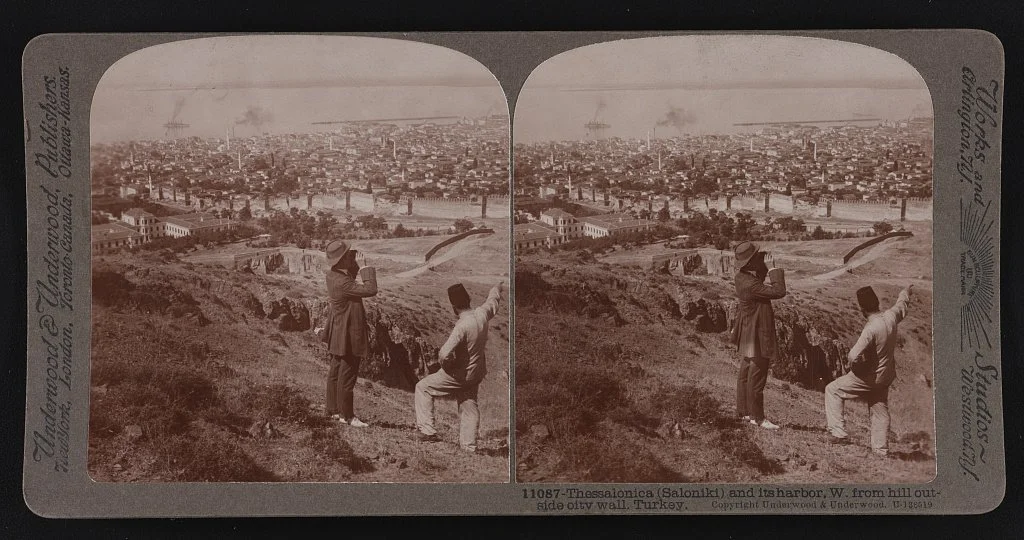
Known to British officials as Salonica, nineteenth-century Thessaloniki was one of the Ottoman Empire’s most important Mediterranean ports. Jewish, Muslim and Orthodox Christian communities lived alongside European merchants, diplomats and missionaries, while commercial routes connected the city with the Balkans, Istanbul and western Europe.
British consuls reported on trade, shipping, public health and political developments; protected British subjects and commercial interests; and cultivated relationships with Ottoman officials, merchants and representatives of the city’s different communities.
During the second half of the century, railways, steam navigation and the reconstruction of the harbour accelerated Thessaloniki’s integration into international markets.
Thessaloniki remained under Ottoman sovereignty until its incorporation into Greece in 1912. The case study follows consular personnel and networks across a major political transition, asking how established forms of influence, protection and cooperation were adapted when an Ottoman port became part of the Greek nation-state.
FUTHER READING
Anastassiadou, Meropi. Salonique, 1830–1912: Une ville ottomane à l’âge des Réformes. Leiden: Brill, 1997.
Mazower, Mark. Salonica, City of Ghosts: Christians, Muslims and Jews, 1430–1950. London: HarperCollins, 2004.
Megas, Giannis. The Consuls at Thessaloniki’s Twenty-Five Consulates, 1685–1912. Athens: Kapon Editions, 2024. [In Greek]
Michailidis, Iakovos D., ed. The Greek Consuls in Thessaloniki: Diplomatic Documents, 1830–1889. Thessaloniki: Society for Macedonian Studies and the Greek Ministry of Foreign Affairs, 2012. [In Greek]